 Back to Research
Introduction And Motivation
When people imagine the future of AI in education, they often focus on intelligence: Can the system solve harder problems? Can it explain better? Can it personalize faster? These are important questions, but there is another question that may be just as important: What kind of social partner should AI be for learners?
ALTER-Math conducted a series of studies to explore whether a teachable AI agent should be designed to feel warmer and expressive or more neutral and task-focused, and how those choices play out through personality, text, and voice. Rather than assuming that a more human-like AI is always better, our research is built around two competing possibilities.
The first is the facilitation hypothesis: if an AI agent feels more socially present, students may feel more connected, engaged, and motivated to learn. The second is the suppression hypothesis: those same human-like cues may distract from the task and increase cognitive load, making a more neutral AI better for deep learning.
This blog post describes our investigations and findings on AI persona engineering for middle school math through three A/B tests. Our research suggests there is no single best persona. Instead, the right design depends on what kind of engagement we want to support and when.
Study 1: Big Five Personality And The Limits Of “More Personality”
The first study (Lyu et al., 2025a) examined whether a teachable agent’s personality changes how students interact with it and what they learn. Drawing on the Big Five personality framework (see Figure 1), the researchers built six versions of the agent: one emphasizing extraversion, one emphasizing agreeableness, one emphasizing conscientiousness, one emphasizing neuroticism, one emphasizing openness, and one with no specific personality emphasis. This was a three-week experiment involving 534 middle school students, all tutoring the agents while working through mathematics problems.
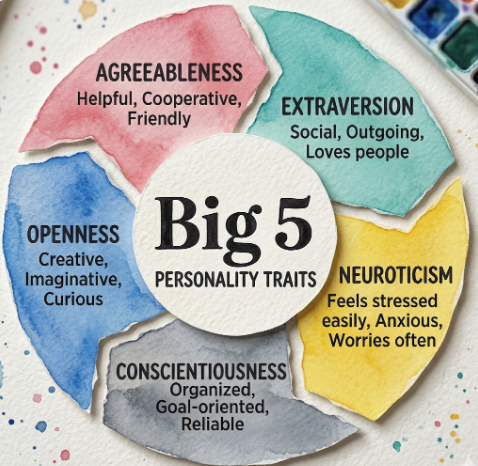
The findings were revealing. Agents emphasizing openness led to more explanations from students than agents emphasizing extraversion or agreeableness, suggesting stronger cognitive engagement. Agents emphasizing extraversion and agreeableness, on the other hand, were more likely to bring out socially warm behaviors such as polite expressions. Perhaps the most surprising result was that the agent with no specific personality often performed very well. Compared to some of the strongly personified agents, it supported more explanation and even outperformed the agreeableness-focused agent on conceptual knowledge application.
Study 2: Tone, Emoji, And The Tradeoff Between Warmth And Focus
The second study (Lyu et al., 2025b) moved beyond broad personality traits to examine everyday communication cues, specifically tone and emoji use (see Figure 2). Participants included 409 middle school students from a partner school district in the southeastern United States. The researchers varied whether teachable agents used a positive or neutral tone, and whether their messages included emojis or not. They then analyzed how students interacted with the agents and what kinds of math knowledge they demonstrated while teaching them.
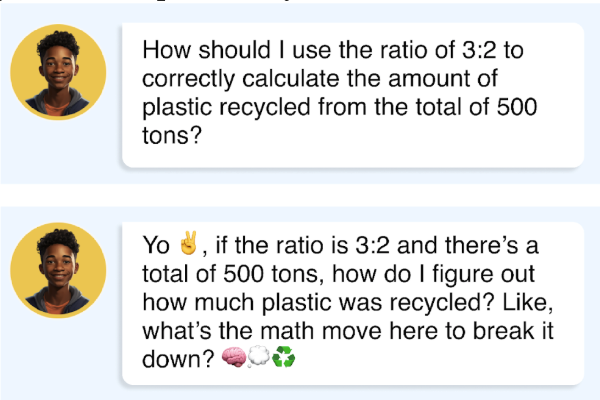
The findings were subtle. A positive tone and emoji use created a more socially relatable environment. Students responded with more polite expressions, encouragement, and other signs of affective engagement. The interaction felt warmer, conversational, and emotionally present. At the same time, a neutral tone and the absence of emojis tended to lead to more detailed instructional behavior. Students provided more instructions, engaged in more elaborative cognitive scaffolding, and were more likely to demonstrate conceptual and procedural knowledge. In a subject like mathematics, where concentration and explanation matter, less expressive agents sometimes supported deeper thinking.
Study 3: Audio Persona And Why Voice Matters
The third study (Li et al., in minor revision) extends persona engineering to voice design. Teachable agents produced spoken responses through text-to-speech, and the researchers manipulated three voice characteristics: gender congruence with the avatar, perceived speaker age, and emotional tone. This created a richer kind of persona, one that students could not only read, but also heard. Across two school districts, 678 students participated. Of those, 310 students had complete pre- and post-test standardized assessment data for analyzing learning gains.
The findings suggest that different agent voice designs support different outcomes. Gender-mismatched sad voices increased students’ conceptual knowledge demonstration and instructional behaviors, while gender-matched cheerful voices produced the strongest standardized learning gains. Voice age showed no significant effects. Together, these results suggest that voice is not just decorative: it shapes how students interpret the agent and respond as teachers. Rather than there being one universally “best” voice, the right design may depend on the phase and goal of learning.
The Bigger Takeaway: Human-Centered AI Is Not One-Size-Fits-All
Taken together, these studies show why persona engineering matters for teachable agents. The finding is not a universal formula like “make AI more human and we will see better learning outcomes.” Sometimes a warmer persona helps. Sometimes a flatter, more neutral design helps. Sometimes a sad voice may spark care and explanation. Sometimes a cheerful voice may support stronger gains over time. The real lesson is that persona should be designed to serve learning goals, not added as a cosmetic feature.
As AI becomes more common in classrooms, the field needs more than smarter models. It needs models that are thoughtfully designed around how humans actually learn. Persona engineering, in this view, is not about making AI cute or charismatic. It is about building educational AI that knows when to encourage, when to step back, and how to support students as active thinkers, not passive recipients. In that sense, ALTER-Math’s contribution offers a roadmap for human-centered AI: one where the design of personality, tone, emoji use, and voice is treated as part of learning science, not just interface polish. And that may be one of the most important shifts educational AI needs right now.