 Back to Research
I. Randomized Controlled Trials
The Learning Engineering Virtual Institute (LEVI) was established to tackle some of education’s most persistent challenges by developing and scaling AI-based tools that transform teaching and learning. This mission requires continuous improvements paired with producing rigorous research to push the field forward. As LEVI enters Year 5, its seven teams are shifting focus from earlier pilot studies to rigorous, large-scale Randomized Controlled Trials (RCTs). At MC² Education, we know that effective RCTs depend on robust recruitment to ensure the large sample sizes needed for generalizable results.
II. Recruitment as Partnership-Building, Not Site Enrollment
Well-designed randomized controlled trials of educational interventions and supports often succeed or fail not because of how schools and districts are meaningfully engaged from the start of recruitment. Rushed or misaligned recruitment can undermine implementation, increase attrition, and weaken study findings. Effective research teams treat recruitment as the beginning of a long-term partnership.
Schools and districts are not simply places where research happens; they are collaborators whose priorities, constraints, and expertise shape what is possible in practice. Recruitment is a process of forming a relationship that establishes the foundation for deeply impactful research built with trust, communication, and mutual understanding.
This process requires transparency around random assignment, expected dosage, data collection requirements, and the specific “asks” of participating sites signals respect for educators’ time and capacity. It also involves navigating the complex, layered decision-making structures of school systems, where district approval does not guarantee teacher participation.
By acknowledging these operational constraints and aligning research goals with district priorities early on, researchers can build trust and reduce the risk of misalignment later.
III. What Makes Recruitment Work: Five Conditions for Strong Partnerships
Our experience across education research suggests that partnerships are most successful when several core conditions are in place. Together, these conditions shape whether partnerships are not only feasible at the outset, but sustainable over the life of a randomized controlled trial.
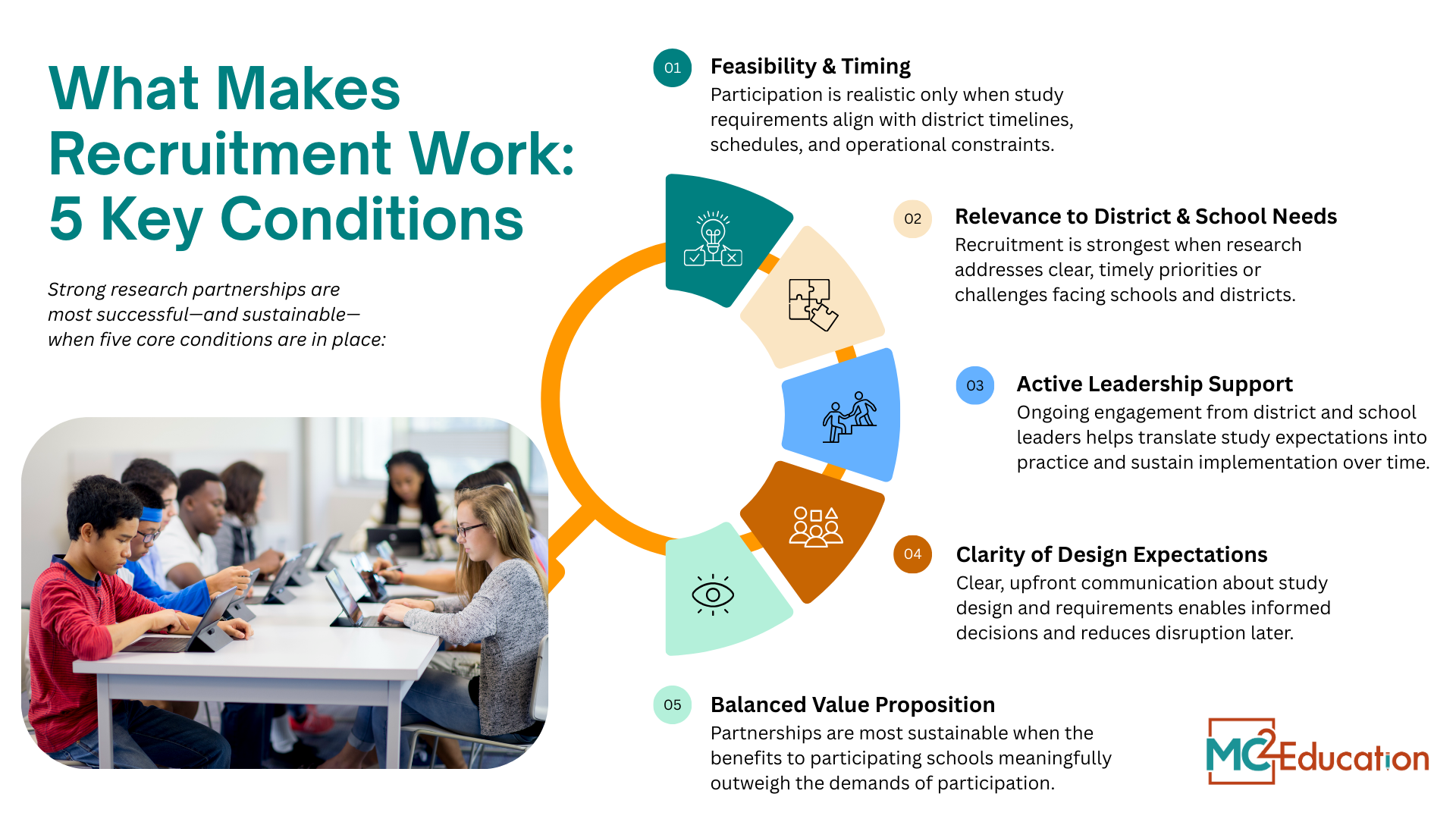
1. Feasibility and Timing
2. Relevance to District and School Needs
Beyond feasibility, participation is most viable when the study addresses a clear and timely need. Districts and schools are more likely to engage when research aligns with instructional gaps, student needs, or pressing system priorities. Studies that respond to real challenges facing educators and students gain traction more readily than those that are merely interesting from a research perspective. Relevance, not novelty, often determines whether participation feels worthwhile.
3. Active Leadership Support
4. Clarity of Design Expectations
5. A Balanced Value Proposition
Finally, participation decisions hinge on whether the benefits of the study outweigh the demands placed on educators and students. These may include access to programs, tools, or data; opportunities to serve more students; or participation in research that contributes to broader knowledge while delivering local value. Sustainable partnerships are most likely when contributions to the field are balanced with tangible benefits for participating communities.
IV. From Recruitment to Sustained Engagement
Once a district or school agrees to participate, it marks the transition into an active research partnership. The period immediately following agreement is often one of the most fragile phases of a study, as expectations move from planning to practice. Onboarding and early implementation support are critical during this transition. Site visits can surface implementation challenges, while onboarding sessions for school leaders and teachers provide opportunities to clarify roles, timelines, and responsibilities before issues escalate. These early interactions also create space for researchers and practitioners to connect as people, helping establish the working relationships which help to navigate implementation challenges.