
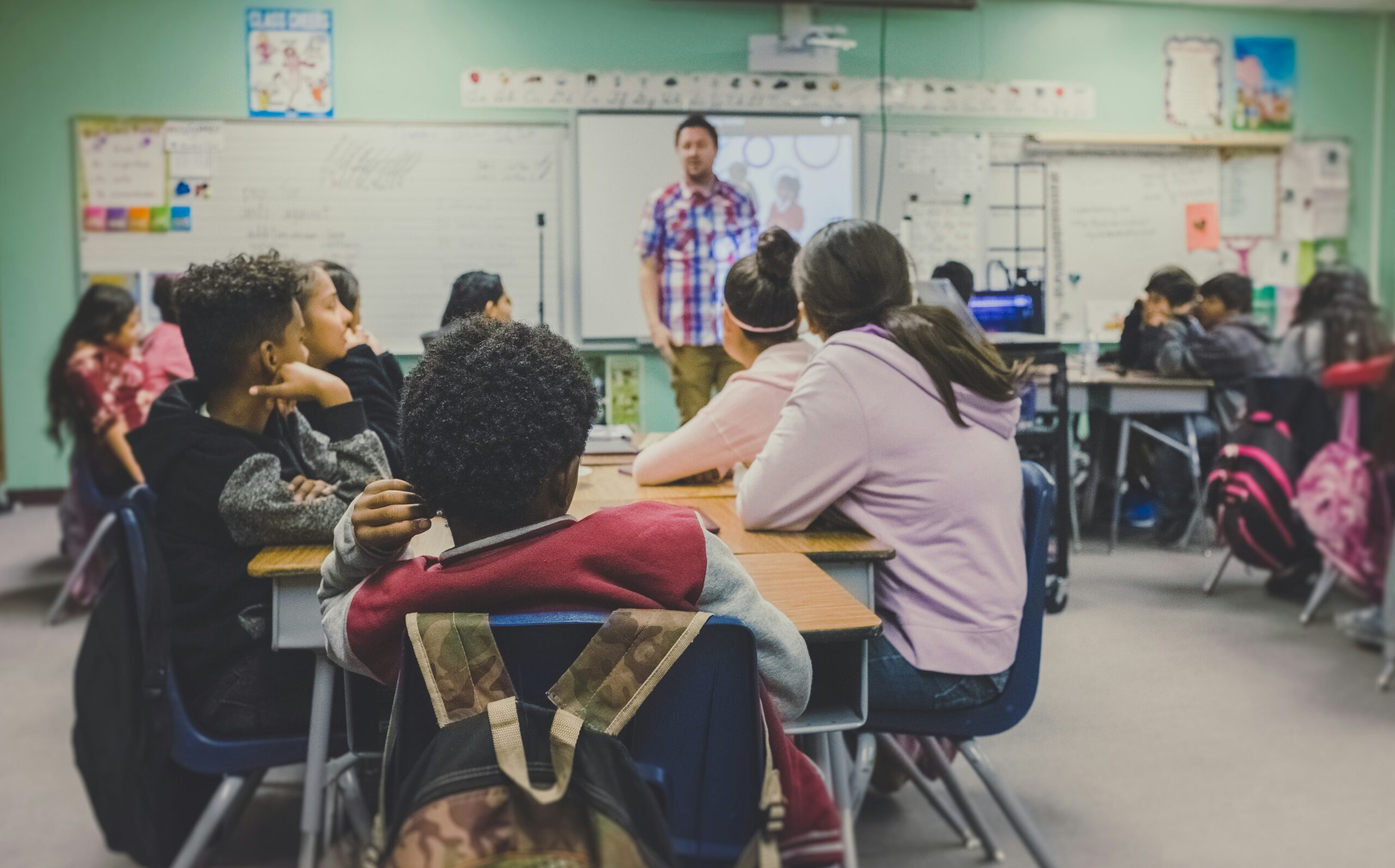
Students’ Perceived Roles, Opportunities, And Challenges Of A Generative AI-powered Teachable Agent: A Case Of Middle School Math Class Abstract Ongoing advancements in Generative AI (GenAI) have boosted the potential of applying long-standing “learning-by-teaching” practices in the form of a teachable agent (TA). Despite the recognized roles and opportunities of TAs, less is known about how GenAI could create synergy or introduce challenges in TAs and how students perceived the application of GenAI in TAs. This study explored middle school students’ perceived roles, benefits, and challenges of GenAI-powered TAs in an authentic mathematics classroom. Through classroom observation, focus-group interviews, and open-ended surveys of 108 sixth-grade students, we found that students expected the GenAI-powered TA to serve as a learning companion, facilitator, and collaborative problem-solver. Students also expressed the benefits and challenges of GenAI-powered TAs. This study provides implications for the design of educational AI and AI-assisted instruction. Keywords Generative AI in education; teachable agent; learning by teaching; AI-assisted instruction; Students’ perceptionsGeneralization, Natural language processing, CollaborationMultiple Choice Question, Large Language Models, Humanin-the-loop.-

Analyzing Student Attention And Acceptance Of Conversational AI For Math Learning: Insights From A Randomized Controlled Trial
Analyzing Student Attention And Acceptance of Conversational AI For Math Learning: Insights From A Randomized Controlled Trial Abstract The significance of nurturing a deep conceptual understanding in math learning cannot be overstated. Grounded in the pedagogical strategies of induction, concretization, and exemplification (ICE), we designed and developed a conversational AI using both ruleand generation-based techniques to facilitate math learning. Serving as a preliminary step, this study employed an experimental design involving 151 U.S.-based college students to reveal students’ attention patterns, technology acceptance model, and qualitative feedback when using the developed ConvAI. Our findings suggest that participants in the ConvAI group generally exhibit higher attention levels than those in the control group, aside from the initial stage where the control group was more attentive. Meanwhile, participants appreciated their experience with the ConvAI, particularly valuing the ICE support features. Finally, qualitative analysis of participants’ feedback was conducted to inform future refinement and to inspire educational researchers and practitioners. Keywords Technology design and development, Conversational AI, Large language models, Math learningGeneralization, Natural language processing, CollaborationMultiple Choice Question, Large Language Models, Humanin-the-loop.-
Automated Feedback For Student Math Responses Based On Multi-Modality And Fine-Tuning
Automated Feedback For Student Math Responses Based On Multi-Modality And Fine-Tuning Abstract Open-ended mathematical problems are a commonly used method for assessing students’ abilities by teachers. In previous automated assessments, natural language processing focusing on students’ textual answers has been the primary approach. However, mathematical questions often involve answers containing images, such as number lines, geometric shapes, and charts. Several existing computer-based learning systems allow students to upload their handwritten answers for grading. Yet, there are limited methods available for automated scoring of these image-based responses, with even fewer multi-modal approaches that can simultaneously handle both texts and images. In addition to scoring, another valuable scaffolding to procedurally and conceptually support students while lacking automation is comments. In this study, we developed a multi-task model to simultaneously output scores and comments using students’ multi-modal artifacts (texts and images) as inputs by extending BLIP, a multi-modal visual reasoning model. Benchmarked with three baselines, we fine-tuned and evaluated our approach on a dataset related to open-ended questions as well as students’ responses. We found that incorporating images with text inputs enhances feedback performance compared to using texts alone. Meanwhile, our model can effectively provide coherent and contextual feedback in mathematical settings. Keywords Generalization, Natural language processing, Collaborationanalytiopen-ended response, auto-scoring, automated comment, image response, multi-modality, fine-tuning